
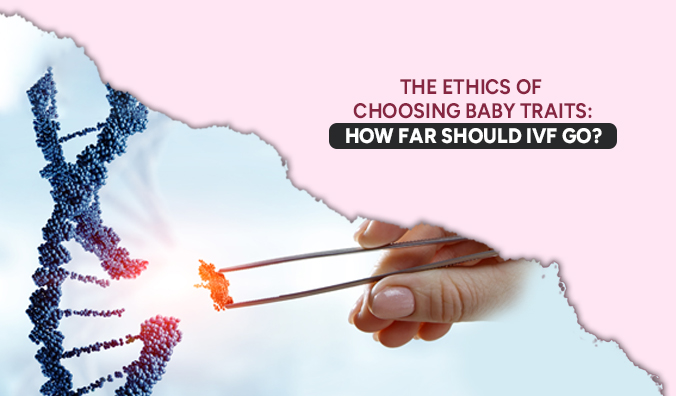
Modern fertility treatments have given hope to millions of families around the world. Along with this hope, however, comes a big question: how far should we go when it comes to choosing traits for our future children?
For parents, the dream of giving their baby the best start in life is natural. Every mother and father wants to protect their child from suffering and give them opportunities to thrive. But when science begins to offer choices beyond health, like appearance, gender, or even intelligence, the ethical waters get murky. Are we creating healthier futures, or are we crossing a line into “designing” children?
How IVF Ethics Have Evolved
When IVF was first introduced, the ethical debate was quite straightforward. People asked whether it was even right to create life outside the human body. Those early discussions often mixed religious, cultural, and scientific concerns.
Over the years, as IVF became more common and successful, those debates shifted. Today, IVF is widely accepted as a path to parenthood for couples and individuals facing infertility. But now, the ethical spotlight has moved to genetic testing and embryo selection.
Preimplantation genetic testing (PGT) allows doctors to screen embryos before implantation. Its main purpose is to reduce the risk of passing on severe genetic disorders. Most would agree this is a positive use of science. But what happens when the same technology can be used to select traits that aren’t about health at all?
The Grey Areas of Choice
It’s not always black and white. Imagine a couple who both carry a gene for a condition but want to implant an embryo that carries only one copy. That child may never get sick but will still be a “carrier.” Is it ethical to choose that embryo?
Or consider sex selection. Some families may want to balance the genders of their children, while others might seek a particular sex for cultural reasons. These decisions go beyond health and venture into preference.
Ethicists suggest that we need to think about relational autonomy, a concept that means decisions aren’t made in isolation. Our choices affect not only ourselves but also our families, communities, and the wider world. What feels like a private decision may ripple outward in unexpected ways.
From Preventing Illness to “Designing” Babies
There’s a big difference between preventing suffering and enhancing traits. Using PGT to avoid a condition like cystic fibrosis or Tay-Sachs is widely accepted. But choosing embryos based on qualities like height, eye color, or even predicted intelligence sparks discomfort.
Some bioethicists, like Julian Savulescu, argue for what he calls procreative beneficence, the idea that parents should choose the embryo with the best chance at the “best life.” While thought-provoking, critics say this approach risks turning parenthood into a project of optimization rather than unconditional love.
After all, part of the beauty of parenting lies in embracing the unknown and welcoming a child for who they are, not who we design them to be.
The Risks: Commodification and Inequality
Another concern is the risk of commodifying children. If parents begin selecting embryos based on social ideals, children could be viewed less as individuals and more as products of choice.
This also raises questions about inequality. If advanced embryo testing and trait selection remain costly, only wealthy families will have access. This could create new social divides where some children are born with every possible genetic advantage, while others are not. Instead of reducing inequality, the technology might widen it.
Different Rules Around the World
How these technologies are used depends a lot on where you live.
In the United Kingdom, embryo selection is allowed only for medical reasons. Sex
Selection for family balancing or preference is strictly prohibited. In the United States, regulations are looser. Some clinics allow elective sex selection and even testing for non-medical traits.
In many other countries, laws are far stricter, often banning non-medical selection altogether. This diversity in regulation reflects cultural, religious, and ethical values. What one society views as a responsible choice, another may see as harmful.
A Responsible Path Forward
So how do we move forward responsibly, honoring both science and ethics? A few guiding principles stand out:
Put health first – The primary goal of embryo selection should remain preventing serious diseases, not enhancing cosmetic traits.
Think beyond ourselves – Choices should consider their effect not just on one family, but on society as a whole.
Protect dignity – Children are not products, and we must resist reducing them to a list of selected features.
Keep access fair – Reproductive technologies must be made more accessible so they don’t worsen social inequality.
Update laws and ethics – Clear, compassionate regulations are needed to guide how these technologies are used.
Final Thoughts
IVF treatment is one of the most remarkable gifts of modern medicine. For many, it turns heartbreak into hope. Using it to prevent illness and suffering feels both ethical and humane. But when the same tools are used to choose traits of preference, the line becomes less clear.
Ultimately, science can offer choice, but it cannot replace the core values of parenthood: love, acceptance, and compassion. The true bond between parents and children doesn’t come from designing the “perfect” baby but from cherishing the unique individual who arrives.